Project concept
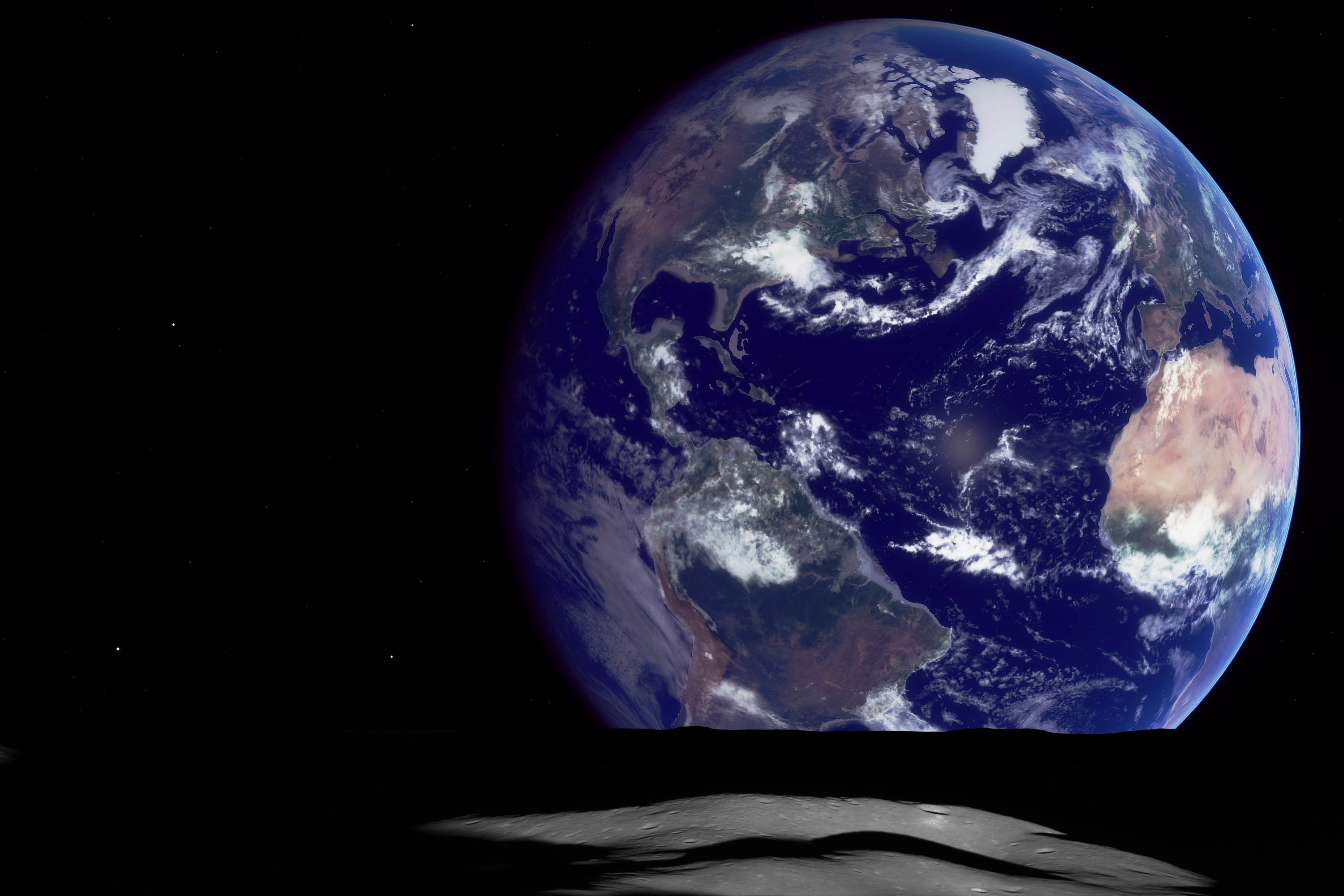
A permanent high-resolution camera on a lunar polar crater rim could show Earth close above the Moon horizon: slow, real, and shared.
The idea
A fixed view of a changing planet
On a crater rim in one of the Moon's polar regions, very high-resolution cameras could permanently record Earth close above the lunar surface and transmit that signal live to Earth.
A permanent live image of our home planet in super high resolution could be a people-connecting message. It could show live earth phases, solar eclipses, and the red glow of Earth's atmosphere during lunar eclipses.
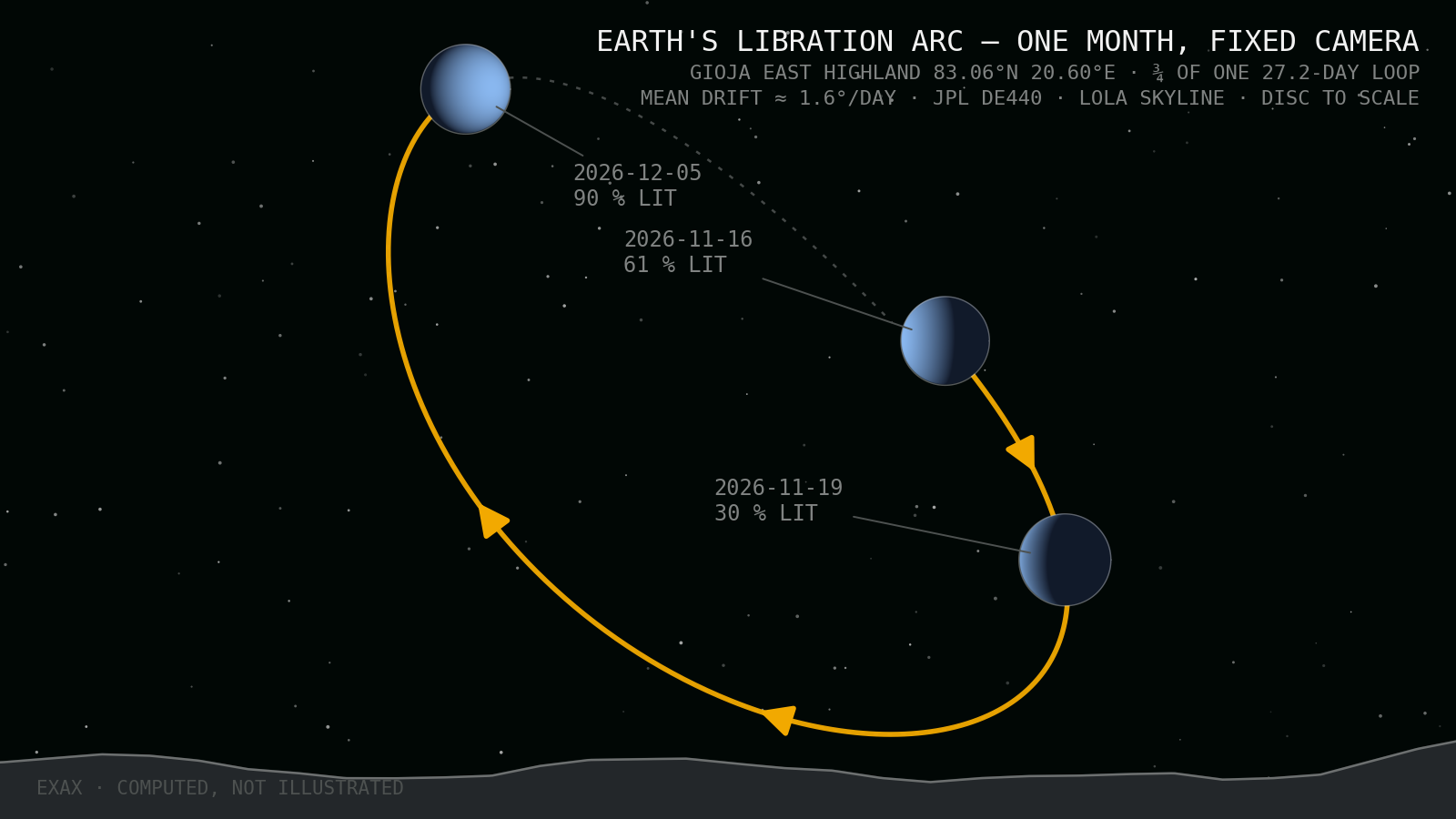
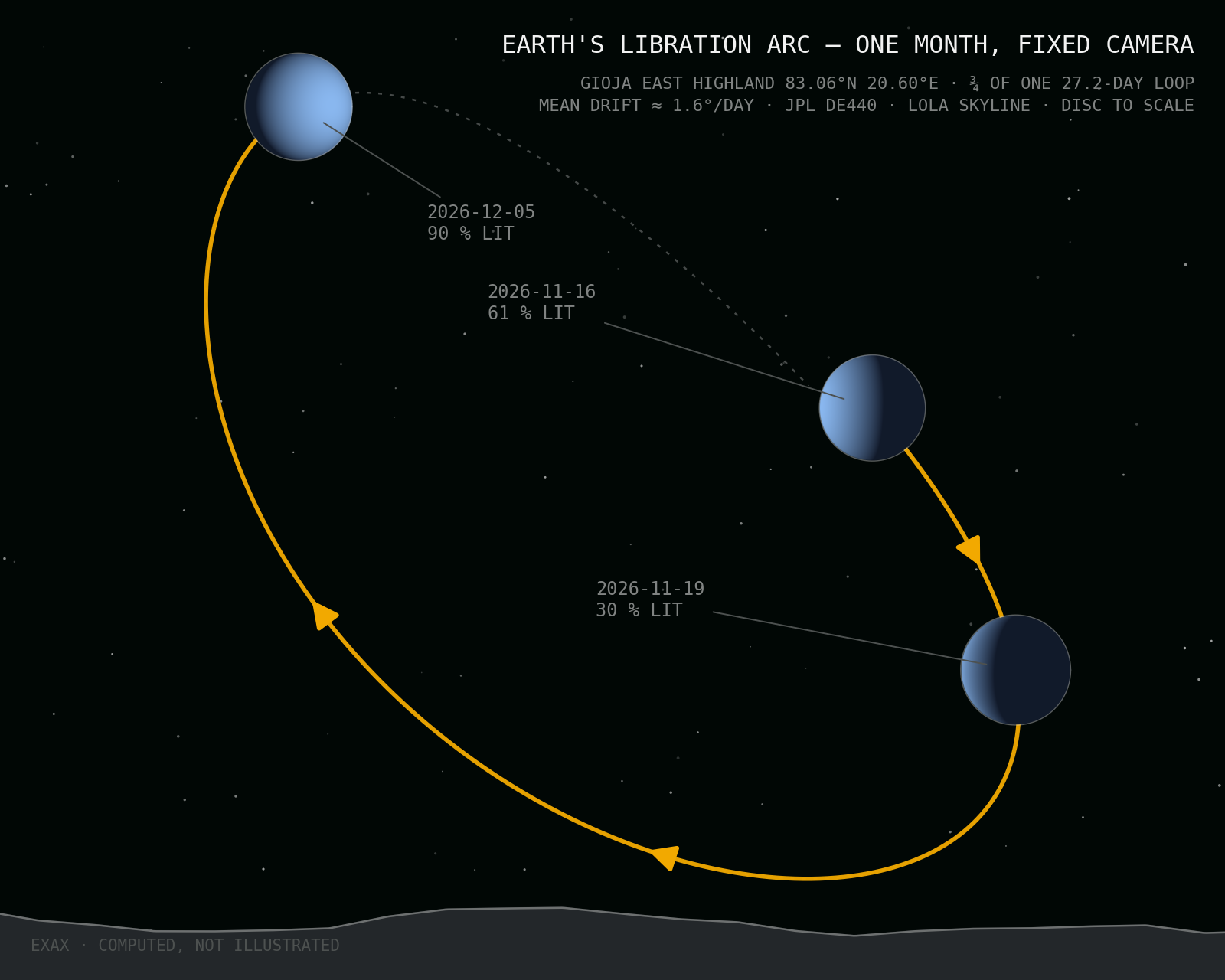
Because the Moon is tidally locked, Earth would not rise and set for a lunar observer in the way the Moon does from Earth. It would stay in roughly the same place while continents, clouds, and light keep changing.
References
Reference and feasibility
From the Earth, the daily Moonrise and Moonset are always inspiring moments. However, lunar astronauts will see something very different: viewed from the lunar surface, the Earth never rises or sets. Since the Moon is tidally locked, the Earth is always in the same spot above the horizon, varying only a small amount with the slight wobble of the Moon. The Earth may not move across the “sky”, but the view is not static. Future astronauts will see the continents rotate in and out of view and the ever-changing pattern of clouds will always catch one’s eye.
To estimate whether such an idea could be realized — and what it would cost — the project asked Prof. Prof. h.c. Dr. Dr. h.c. Ulrich Walter, astronaut and head of the Chair of Astronautics at Technical University of Munich. His 2019 email reply:
Dear Mr. Kindermann,
positioning 8K cameras on a crater rim in one of the two polar regions of the moon is a dream of the future, because we first have to return to the moon (2024) and only on follow-up missions (2028?) we might position cameras on crater edges with live transmission. There is no space nation, which has such thoughts at the moment. At the moment it’s all about how we get back to the moon (techniques, money).
Unless you also provide the money for your idea. What is needed is an estimated €500 million. You do not need manned missions to do this, but a few unmanned missions will do, such as SpaceIL (Israel), which offers around €100 million per mission.
Many greetings
U. Walter
Mission design
Questions the project has to answer
A permanent camera on the Moon raises a series of open design questions. Each one is being worked through from first principles, and each links to the part of the project that explores it in depth.
Location
Where on the Moon can a camera hold Earth and the lunar horizon in one frame? A re-validated study grades every candidate by proof — two polar summit sites, one at each pole, lead the map.
Moon locationsCamera system
Which camera system can deliver the required high-resolution live image quality for long-term lunar operation?
Camera systemsTransport
Should the hardware be placed directly by a lunar lander, or should a vehicle search for the final viewing position on site?
TransportPower
How can the installation be supplied with energy in the polar region, including solar-panel elevation and rotation needs?
Power supplyTransmission
How could a high-resolution video stream travel back to Earth: laser link, satellite communication, or another relay architecture?
TransmissionFraming
Should the image show the complete area where Earth appears to dance, or should a lens follow Earth in a close-up shot?
Image and framingVisual language
A live image instead of a moving spectacle
The project favors the calm presence of a static or slowly tracking 8K image over quick pans and cuts. On a large high-resolution display, the value would be the feeling of watching Earth directly from another world.
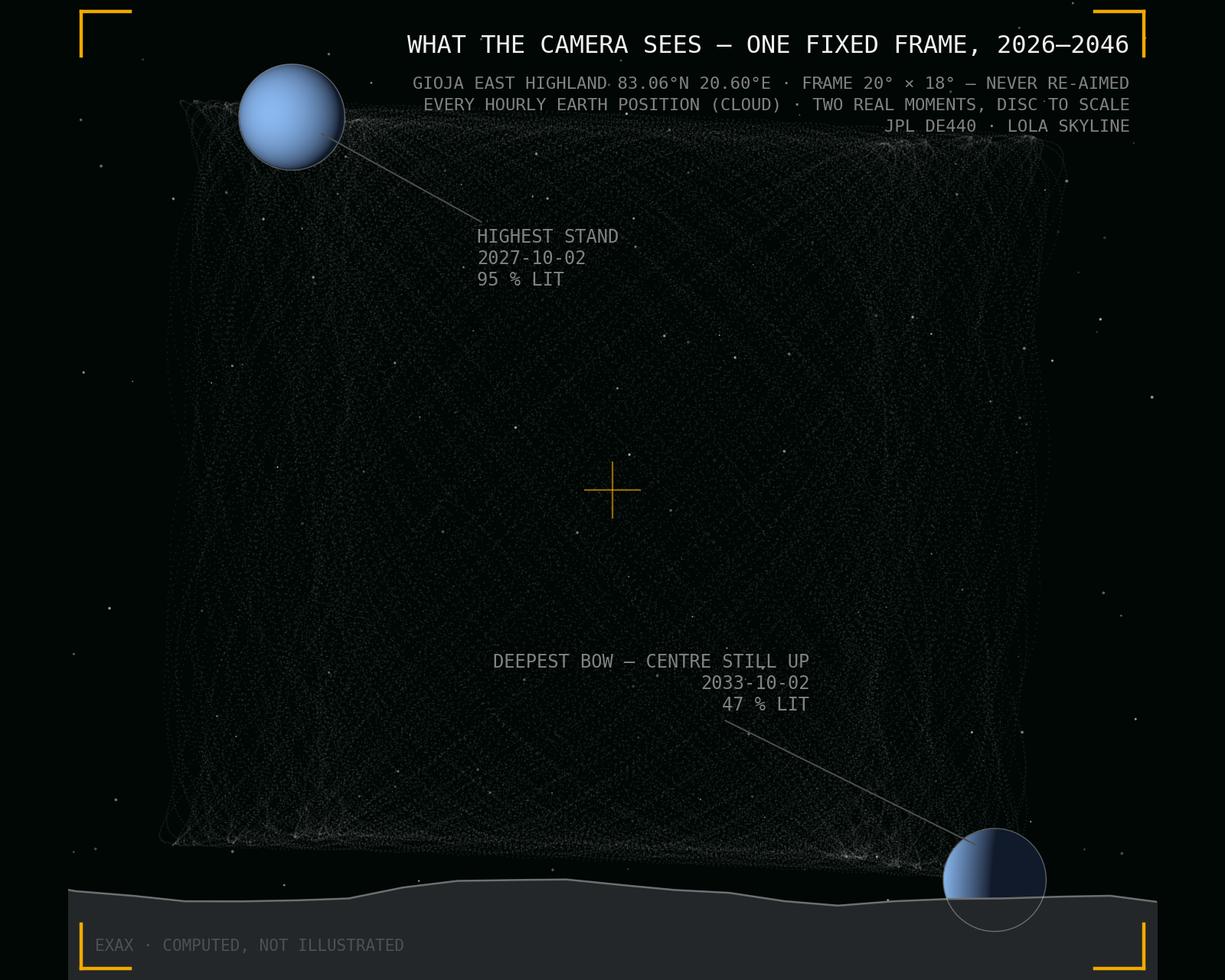
Rather than tracking Earth, a single fixed wide shot can hold it in frame at all times: across the full 18.6-year libration cycle Earth stays within a compact window of roughly 20° by 18°, so a camera with that field of view never loses it. A changeable filter is still needed when the Sun passes behind Earth during an eclipse.
Candidate sites
Two selected sites, one at each pole
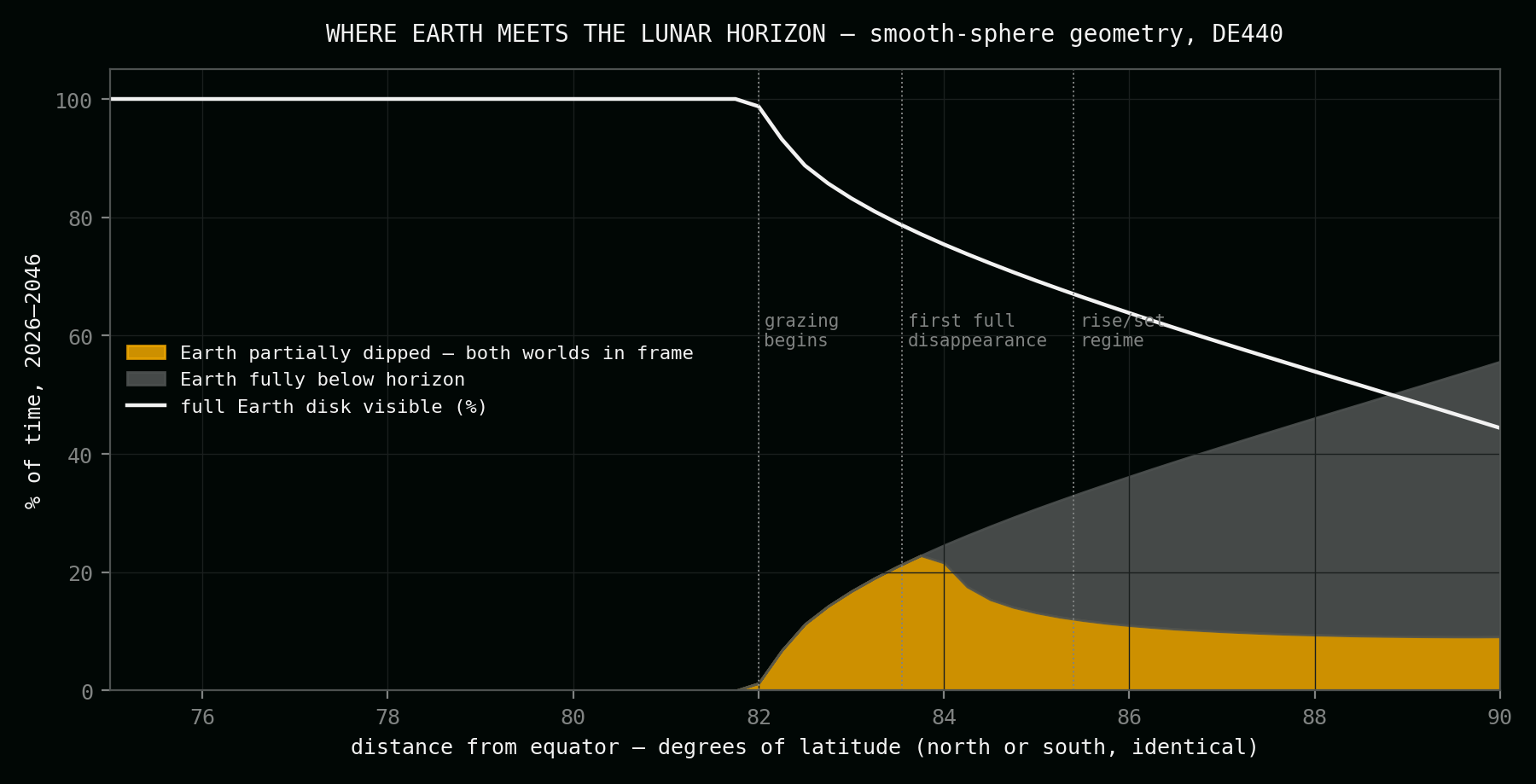
A positional-astronomy study derived where in the lunar sky Earth stands at every hour of the full 18.6-year libration cycle — built on JPL's DE440 integrated lunar orientation, audited against NASA's Horizons service, and tested against skylines ray-marched from NASA's laser elevation maps. The rule it scored against is the project's brief in one sentence: the horizon may cut into Earth's disk, but the planet must never sink more than half below it.
Exactly one site per hemisphere survives that rule robustly. In the north, the Gioja East Highland at 83°04′N — a quiet rise where Earth bows into a sunken skyline ten times a year and is never fully hidden. In the south, the northeast shoulder of Mons Mouton at 84°34′S — the lunar south's highest mountain, where the plateau rim takes a bite of Earth thirteen times a year, one hour in thirteen, with the same guarantee: never more than half.
Origin image
The old image behind the new question
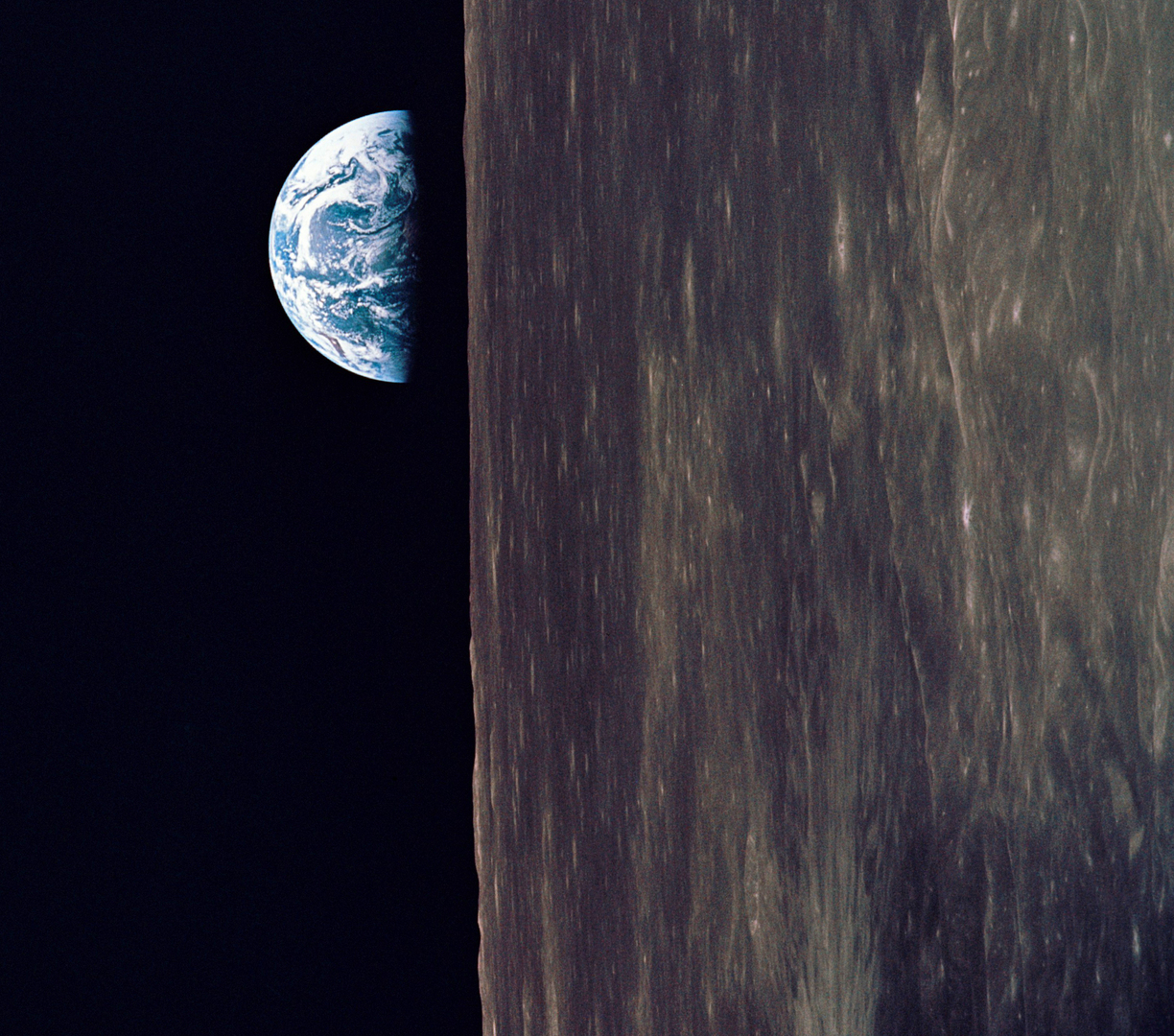
The Apollo-era Earthrise view showed Earth from another world. exax turns that emotional image into a design question: what would change if this view became permanent, live, and high-resolution?
Follow the project as it takes shape
exax is an open concept under active study. Explore the parts that interest you, preview what the view could look like, or help carry the idea forward.