
Power at the poles
Keeping a camera watching Earth from the Moon for years would take a power concept matched to the polar lighting geometry — long shallow arcs of sun, energy held through nights of up to three weeks, and redundancy so the view never stops.
Sunlight
Sunlight, measured against the real horizon
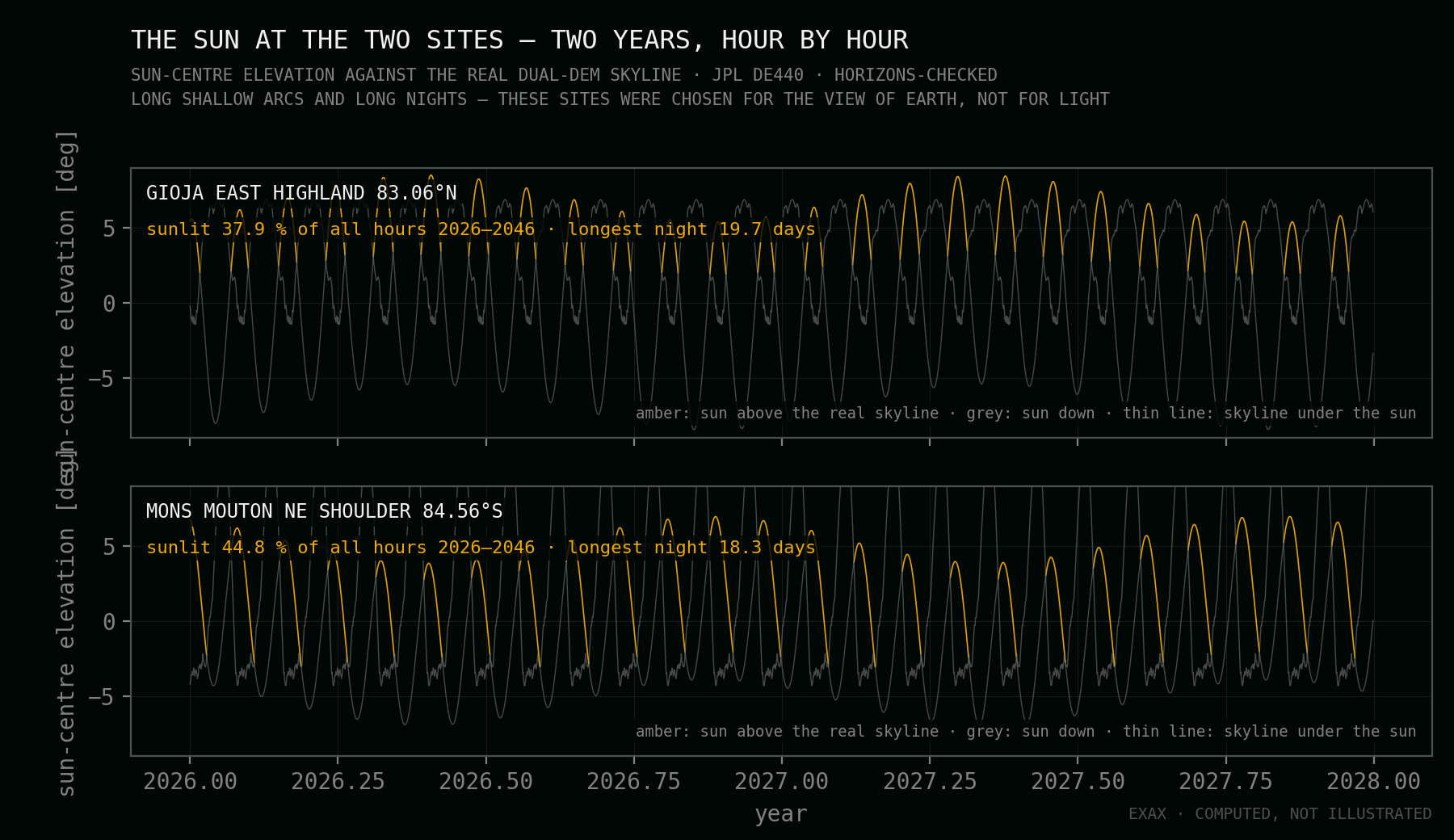
Polar terrain shapes the whole energy budget. At the two featured sites the Sun moves in long, shallow arcs — but measured against the real, laser-built skylines it stands above the horizon only about four hours in ten. These spots were chosen for their view of Earth, not for record sunlight. A raised, slowly steerable array tracking the shallow arc remains the natural design direction — not yet a verified engineering solution — and the budget starts from storage, not from continuous light.
Storage
Energy held for shadow and night
Even at a well-chosen polar site, shadows fall and darkness comes. A practical system would carry stored energy to keep the camera, pointing, thermal control, processing, and transmission running through those periods — sized to the worst-case gap rather than the average.
- Reserves sized to bridge local shadow and night — the longest computed dark stretch at either site is just under three weeks
- Thermal management for extreme cold and heat swings
- Charging windows planned around the polar lighting cycle
Reliability
Redundancy keeps the view alive
A single point of failure means darkness. The concept favours layered backup — independent paths for generation, storage, and control — so that if one element falters, another can carry the load. The aim is a system that keeps watching Earth without a person on hand to intervene.
- Independent generation and storage paths, not one chain
- Graceful fallback to a reduced power mode if needed
- Designed for years of unattended operation
Questions
Powering a long-running camera near a lunar pole raises a few recurring questions. Here is how the concept currently thinks about them.
Why the lunar poles?
Near the poles the Sun's arc is shallow and slow, which suits raised, steerable arrays — but the site choice was driven by Earth's visibility, not light. Measured against their real skylines, the two featured sites are sunlit 37.9 % and 44.8 % of all hours; lower latitudes instead alternate roughly two lit weeks with a full two-week night.
What about the dark periods?
No polar site is lit all the time. The concept assumes stored energy to bridge local shadow and night, sized to the longest expected gap rather than to an average.
Why build in redundancy?
With no one on the Moon to fix a fault, a single failure could end the live view. Independent generation, storage, and control paths let one element take over if another degrades.
What draws power beyond the camera?
A live system needs power for more than imaging — pointing, thermal control, on-board processing, and transmission all add to the budget, and the design has to account for all of them together.
How does the site choice affect power?
Lighting depends on the exact crater-rim geometry, so power planning follows the location study. The horizon, elevation, and local shadows all shape how much sunlight an array would actually see.
Is any of this settled engineering?
No. Everything here is a design direction for a concept, not a verified solution. The point is to show the power problem is approachable, not to claim it is already solved.
Want to go deeper?
The power concept connects to the site, camera, transport, and transmission work. Follow the threads, or get in touch with a specific question.